Welcome to

UNIVERZAL SOPOT

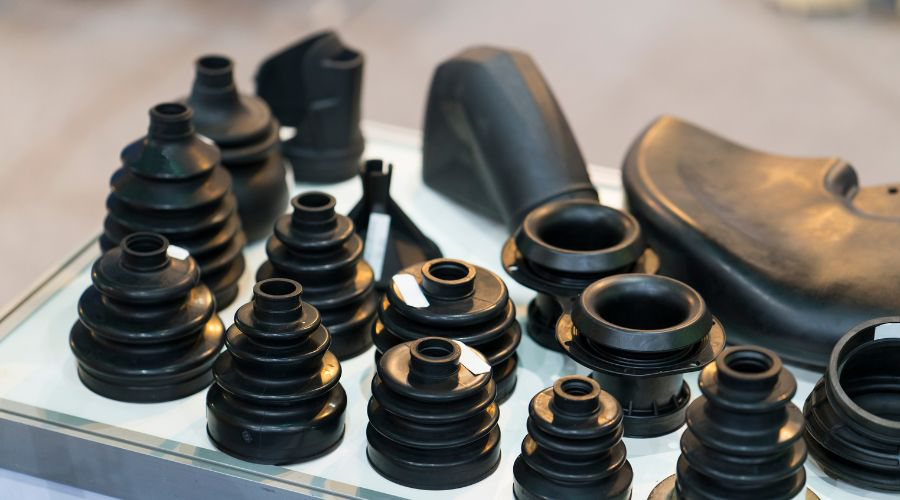
Technologically tested raw rubber compounds and vulcanized rubber products.
A tradition of quality since 1989 – expertise in rubber compound preparation, molding, and extrusion.
We develop solutions according to your specifications and industry standards.

OUR PROCESSES

Industrial Rubber Mixing – Compounding

Industrial Rubber Shaping – Rubber Moulding

Industrial Rubber Extrusion – Rubber Extrusion

“Experience and knowledge are on our side; modern technologies and environmental awareness are our future.”

Bojan Lepotić – Owner/Director

OUR PRODUCTS

ELASTOMERS FROM OUR OFFER

Natural Rubber (NR)

  • What is it? A natural elastomer obtained from the latex of the rubber tree.

  • Chemical formula: (C5H8)n

  • Temperature range: -55°C to +85°C

  • Vulcanization: With sulfur, accelerators, and antioxidants

  • Resistance: Good mechanical properties, high elasticity, wear resistance

  • Weaknesses: Low resistance to oils, solvents, and weathering

  • Applications: Car tires, conveyor belts, seals, medical products

Polybutadiene (BR)

  • What is it? A synthetic elastomer with high abrasion resistance.

  • Chemical formula: (C4H6)n

  • Temperature range: -100°C to +90°C

  • Vulcanization: With sulfur or peroxide

  • Resistance: Excellent flexibility at low temperatures, high elasticity

  • Weaknesses: Poor resistance to oils and solvents

  • Applications: Tires, footwear, technical rubber products

FKM (Fluoroelastomer – Viton™)

  • What is it? A fluorocarbon elastomer known for exceptional chemical and temperature resistance.

  • Chemical formula: (C2H2F4)n

  • Temperature range: -20°C to +260°C

  • Vulcanization: With peroxide or bisphenol

  • Resistance: Excellent resistance to oils, fuels, chemicals, high temperatures, oxidation, and weathering

  • Weaknesses: Poor resistance to ketones, esters, and organic acids; may become brittle at very low temperatures

  • Applications: Aerospace industry, automotive seals, O-rings, chemical plants, industrial pumps

Nitrile (NBR)

  • What is it? A synthetic elastomer with high resistance to oils.

  • Chemical formula: (C3H3N-C4H6)n

  • Temperature range: -55°C to +135°C

  • Vulcanization: With sulfur or peroxide

  • Resistance: Excellent resistance to oils, fuels, greases, and chemicals

  • Weaknesses: Low resistance to ozone, UV, and weathering

  • Applications: Fuel hoses, industrial seals, gloves

Neoprene (CR)

  • What is it? A synthetic rubber resistant to chemicals and weathering.

  • Chemical formula: (C4H5Cl)n

  • Temperature range: -40°C to +115°C

  • Vulcanization: Mainly with peroxide

  • Resistance: Resistant to oils, fuels, weather conditions, and flame

  • Weaknesses: Less flexibility compared to NR and BR rubber

  • Applications: Seals, hoses, protective clothing, automotive industry

SBR (Styrene-Butadiene Rubber)

  • What is it? A synthetic elastomer used as a substitute for natural rubber.

  • Chemical formula: (C8H8-C4H6)n

  • Temperature range: -50°C to +100°C

  • Vulcanization: With sulfur or peroxide

  • Resistance: Good abrasion resistance, flexibility, resistance to water and organic acids

  • Weaknesses: Poor resistance to oils, solvents, and weathering

  • Applications: Tires, conveyor belts, footwear, technical rubber products, seals

Silicone (SI)

  • What is it? An elastomer with exceptional temperature and chemical stability.

  • Chemical formula: (SiO)n

  • Temperature range: -60°C to +250°C

  • Vulcanization: With peroxide or platinum catalysts

  • Resistance: Extreme temperatures, chemical inertness, biocompatibility

  • Weaknesses: Poor mechanical strength, low elastic modulus

  • Applications: Medical equipment, electronic components, seals

IIR (Isobutylene-Isoprene Rubber – Butyl Rubber)

  • What is it? A synthetic elastomer known for exceptional gas impermeability and chemical resistance.

  • Chemical formula: (C4H8-C5H8)n

  • Temperature range: -45°C to +120°C

  • Vulcanization: With sulfur or peroxide

  • Resistance: Excellent resistance to gas diffusion, weathering, acids, and bases

  • Weaknesses: Poor resistance to oils, fuels, and solvents

  • Applications: Inner linings of tires, seals, pharmaceutical packaging, electrical insulation

Contact us